In recent years, the biomedical effects of hydrogen have received increasing attention from scholars in various fields. But its low solubility in water and short action time also limit its application. Nanobubbles have a large surface area, high internal pressure, and negatively charged surface, which can accelerate the dissolution of gases in liquids and enhance long-term stability. Therefore, this technology lays the foundation and conditions for the application of hydrogen molecules.
Associate Professor Liu Shu's team at Beihang University used single-cell thermophilic Tetrahymena as a model organism and copper ions as a representative environmental pollutant to explore the removal effect of hydrogen molecules on different types of reactive oxygen species in the form of nanobubbles and clarify specific chemical reaction pathways. And further explore the impact on endogenous antioxidant enzyme activity and related gene expression, and analyze its mechanism of action in different stages of oxidative stress.
The results showed that hydrogen nanobubbles improved the removal ability of different reactive oxygen species, removing H2O2, O2 •−, and • OH in molar ratios of 8:1240:1 and 267:1, respectively (Figure 1). However, the selective oxidation theory of hydrogen suggests that hydrogen molecules cannot directly remove H2O2 and O2 •−, and this difference in results may be due to the presence of hydrogen free radicals in hydrogen nanobubbles. The interior of the nanobubble is an extreme high-pressure environment, with a density several tens of times higher than the air density. The pressure ranges from 120 psi to 240 psi, and the hydrogen and oxygen inside the nanobubble can even react with each other. Therefore, it is speculated that the hydrogen molecules inside the nanobubble have higher activity.
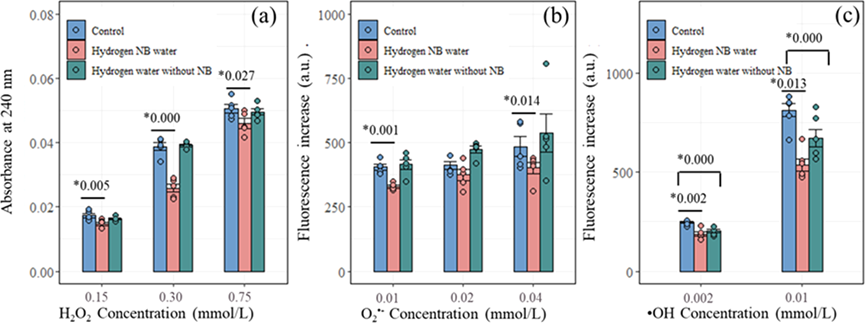
Figure 1 Removal effect of hydrogen nanobubble water on exogenous H2O2 (a), O2 •− (b), and • OH (c)
Furthermore, the existence of hydrogen radicals in hydrogen nanobubble water was verified indirectly by converting hydrogen radicals (• H) into hydroxyl radicals (• OH) and hydrogen peroxide (H2O2) (Figure 2). On the one hand, hydrogen free radicals reduce the energy barrier of the reaction between hydrogen and free radicals, and on the other hand, they increase the rate constant of the reaction between hydrogen and free radicals, making it possible to remove different types of reactive oxygen species (H2O2, O2 •−, and • OH).
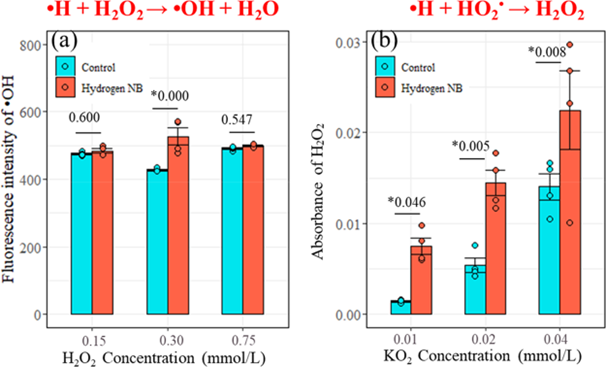
Figure 2 Verification of the existence of hydrogen free radicals in hydrogen nanobubble water
In addition to direct chemical reactions with free radicals, hydrogen nanobubbles may also have an impact on endogenous antioxidant defense systems. Continuous exposure to hydrogen nanobubble water for 24 hours significantly increased the enzyme specific activity and related gene expression of superoxide dismutase (SOD) and glutathione peroxidase (GSH Px). Based on the above results, this study divided the copper induced oxidative stress process into two stages: the oxidative defense stage (0-6 hours) and the oxidative inhibition stage (6-24 hours) (Figure 3). In the oxidation defense stage, hydrogen nanobubbles not only directly remove reactive oxygen species, but also enhance antioxidant capacity by increasing GSH Px activity and related gene expression, thereby indirectly removing reactive oxygen species. During the oxidation inhibition stage, hydrogen nanobubbles mainly exert antioxidant effects by increasing the activity of SOD and GSH Px, as well as the expression of corresponding genes.
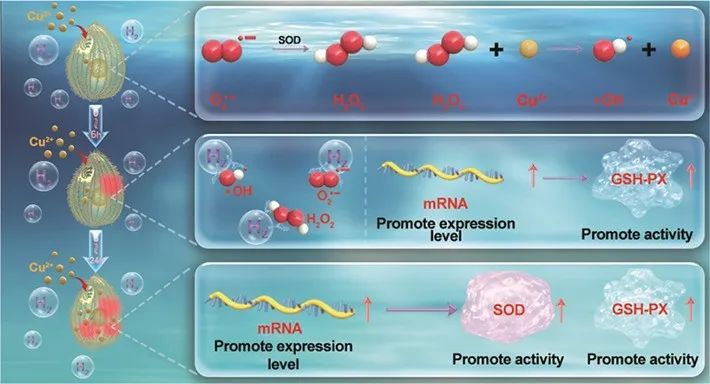
Figure 3: The mechanism of action of hydrogen nanobubble water in different stages of oxidative stress.
Corresponding author: Liu Shu, PhD, associate professor, doctoral supervisor, School of Space and Environment, Beihang University. Mainly engaged in research on micro nano bubble technology, water treatment technology, and ecotoxicology. As the person in charge, responsible for the National Natural Science Foundation Youth Fund and General Fund, and was approved for the Beihang Top Talent Support Program in 2017. Published over 40 papers in international academic journals such as Environmental Science&Technology and Water Research