The principle of producing hydrogen gas in a hydrogen rich water cup can be broadly divided into two methods: chemical and electrolytic. By comparing the different hydrogen production methods and their prices, we can summarize which brand of hydrogen rich water cup is more affordable and which brand is better. The proton exchange membrane mentioned in the Hydrogen Love World Rich Hydrogen Water Cup is a hydrogen production method that does not produce residual chlorine and ozone, which is worth paying attention to. The editor in chief of Hydrogen Love World spent nearly 4 hours showcasing the three principles of hydrogen production in hydrogen rich water bottles through animation and text, hoping to make hydrogen enthusiasts understand in seconds.
Introduction type hydrogen rich water cup: Chemical methods generally use magnesium metal
By using a process to produce minerals primarily composed of magnesium, the principle of hydrogen production is utilized through the reaction of magnesium with water.
Equation: Mg+2H2O=Mg (OH) 2+H2 ↑ Slowly reacts to produce hydrogen, and if hot water is used, the reaction will strengthen.
Advantages: The hydrogen rich water cup process based on this principle is simple and cost-effective.
Defect: Magnesium will be consumed, so the filter element needs to be replaced periodically. Even more troublesome is that it requires a large amount of drinking hydrogen rich water to show the effect of hydrogen. However, this hydrogen production method produces magnesium ions, which are needed by the body. However, the human body absorbs a large amount of magnesium ions, which increases the complexity of the problem.
Outlook: The reaction between calcium hydride and water is CaH2+2HO=Ca (OH) 2+2H ↑, which is commonly used by mountaineers to produce hydrogen gas. By analogy, in the future, hydrogenated calcium or hydrogenated coral calcium can be made into capsules and enter the human stomach, which can slowly and continuously release hydrogen.
Universal hydrogen rich water cup: ordinary electrolysis method
This is currently used by the vast majority of hydrogen rich water cup manufacturers, where platinum electrodes are placed in water at the same time, and hydrogen and oxygen are simultaneously produced and discharged into the water during electrolysis. The price of this hydrogen rich water cup ranges from 300 to 1200 yuan, with the price of the Japanese Jiangtian water vegetarian water cup being over 2000 yuan. Many consumers have found that Jiangtian water vegetarian water cups are not suitable for China, and there will be an odor when used in China, which is ozone and ozone. The root cause is that most of the imported water bottles are developed for the Japanese and Korean markets. Japanese tap water can be consumed directly without heavy metals and other organic pollutants, and there is no residual chlorine present. And China's tap water needs to be sterilized by adding chlorine gas, and the chlorine content of tap water containing chlorine will increase more than five times after digestion.
Electrode reaction formula, anode: 4OH --4e -=O2 ↑+2H2O, cathode: 4H++4e -=2H2 ↑
But the anode still has two side reactions, one of which is the generation of ozone: 3H2O-6e -=O3+6H+
Another side reaction is the production of chlorine: 2Cl --2e --==Cl2 ↑
The generation of ozone is unavoidable. In this popular hydrogen rich water cup, there are usually mineral particles inside to improve taste, and some can partially absorb residual chlorine and ozone.
If pure water electrolysis is used, residual chlorine and ozone will be reduced accordingly. However, many of these cups on the market cannot produce hydrogen with pure water or their hydrogen production capacity is greatly reduced because the conductivity of pure water is poor. If distilled water or deionized water is used, this type of cup will not work at all.
Advantages: Low cost, easy to popularize.
Defect: Unable to completely solve the problem of residual chlorine and ozone. Low threshold, numerous manufacturers, and uneven quality.
High end hydrogen rich water cup: SPE proton membrane electrolysis, hydrogen oxygen separation
SPE membrane is the popular proton exchange membrane for hydrogen fuel cells today. The process of hydrogen oxygen separation and hydrogen rich water cup electrolysis is the reverse process of fuel cell power generation. The cathode of hydrogen and oxygen separation produces hydrogen above the SPE membrane, while the anode below produces oxygen, ozone, and residual chlorine, which are discharged to the bottom of the cup, resulting in high hydrogen purity.
In addition, there is an incredible feature, even for deionized water, SPE proton membrane electrolysis of hydrogen rich water cups still works. Because SPE membranes also serve as electrolytes.
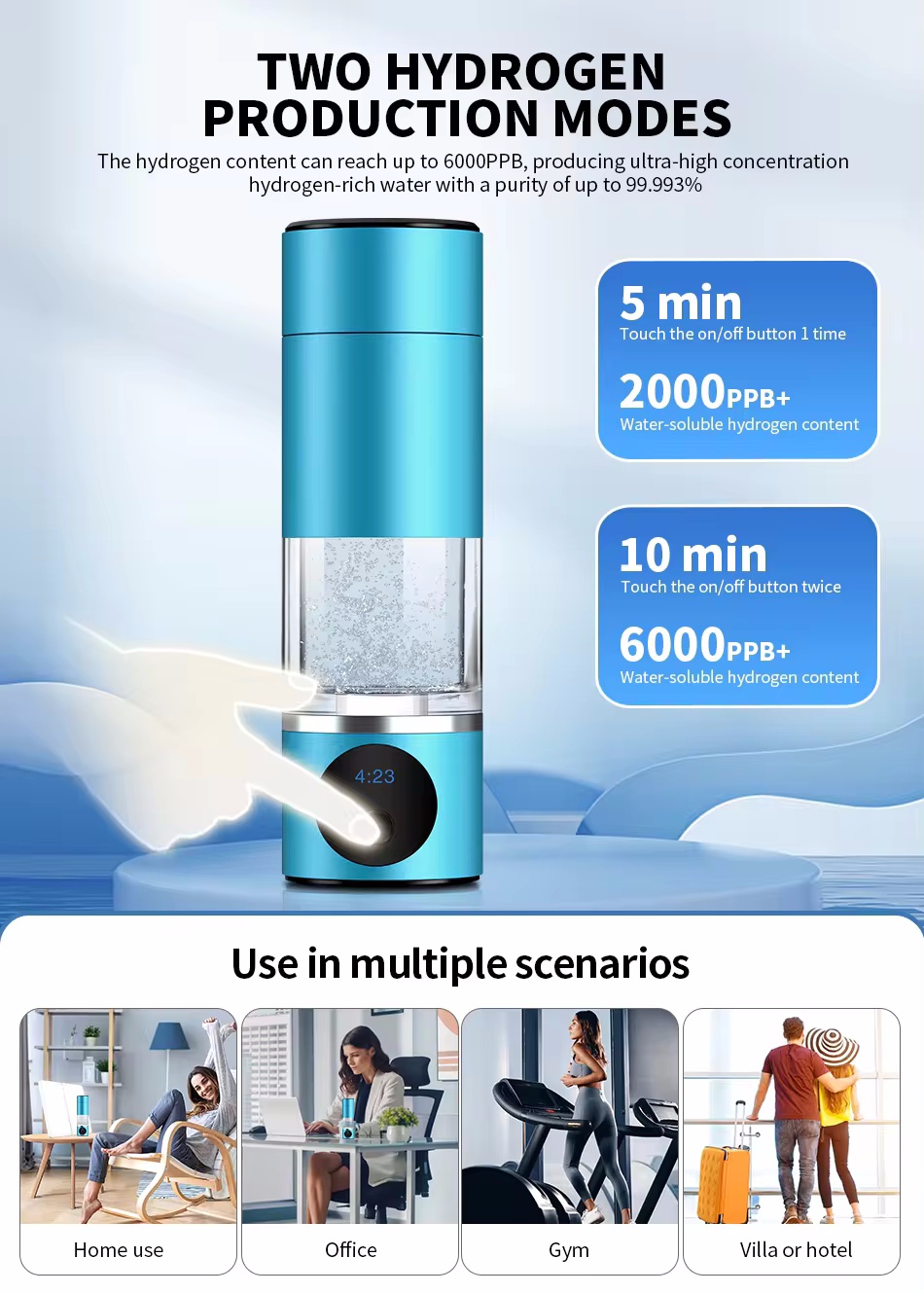
Advantages: The generated hydrogen has high purity, can breathe, high hydrogen water concentration, and no residual chlorine or ozone is produced.
Disadvantage: SPE proton membranes are expensive, and currently only a few manufacturers internationally can produce SPE proton membranes with qualified quality. The Hydrogen Love World Rich Hydrogen Water Cup uses this SPE proton membrane water cup, which has extremely high hydrogen production purity, high hydrogen water concentration, and no residual chlorine or ozone production. You can use it with confidence.